
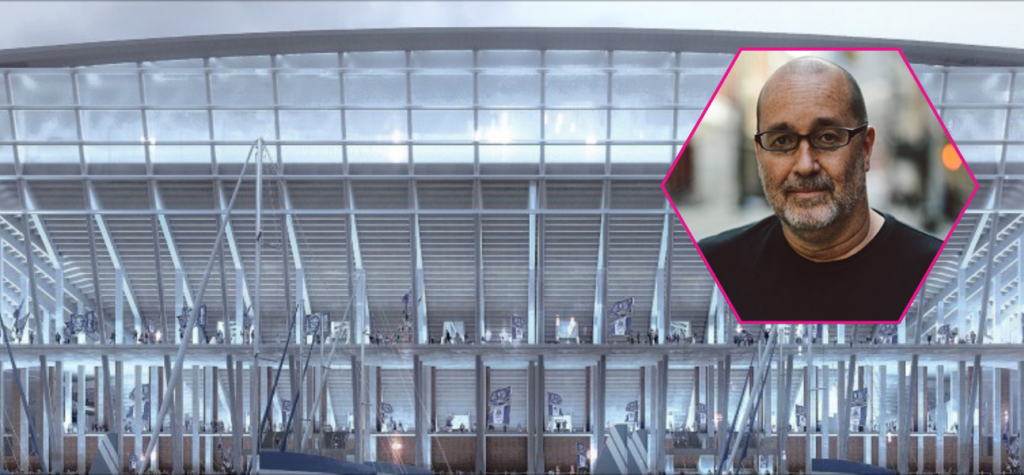
Ahead of TheStadiumBusiness Design & Development Awards in Manchester, we caught up with one of the judges, Eleni Kalapoda.
Kalapoda is a New York-based architect and urban designer, and founder of Embedded Climates Design Group, an international practice designing more efficient, intelligent and sustainable buildings and cities.
She has collaborated with Foster + Partners (King Salman International Airport), Kengo Kuma (Ellinikon Riviera Galleria), Renzo Piano (National Opera and Library Complex), Bernard Tschumi (Acropolis Museum) and Perkins Eastman (Resorts World New York), contributing to stadiums, entertainment and hospitality destinations, aviation hubs, cultural institutions and resilient masterplans.
Check out the full list of finalists here.
TheStadiumBusiness: What stood out to you the most about this year’s entries?
Eleni Kalapoda: “A shift in where the ambition lies. Not long ago, the headline of a stadium submission was its roof or its silhouette. This year, the most compelling entries began with the people inside: how fans arrive and disperse, where families linger, how a concourse feels at half-time, and how the venue serves its neighbourhood on the 300 or so days a year when no match is played. The finest projects treated the stadium not as a monument to be admired from afar, but as a working piece of the city, open, legible and generous long after the final whistle.”
TSB: Have you noticed any emerging trends this year compared to previous editions?
EK: “Three, and they reinforce one another. The first is right-sizing: owners are choosing capacities they can genuinely fill, because atmosphere, not scale, is what fans remember and what sponsors pay for.
“The second is the year-round venue, where concerts, community sport, conferences and everyday public space are written into the brief from the first sketch rather than bolted on afterwards.
“The third is evidence: sustainability claims are increasingly grounded in measured data on energy, water and embodied carbon, and the most persuasive entries allowed those numbers to shape the architecture rather than merely decorate the submission.
TSB: How is the rise of AI and data changing early decisions for owners and operators?
EK: “Its greatest value lies at the very beginning, when decisions are cheapest to change and most costly to get wrong. Teams can now test hundreds of options for capacity, bowl geometry, sightlines, crowd flow, energy and cost in the time it once took to draw a single scheme, so owners see the consequences of a choice before they commit capital to it.
“Data from venues already in operation is flowing back into new briefs, too, from concession demand to queueing patterns. What these tools cannot replace is judgement: deciding which option is right for a club, its supporters and its city remains a human responsibility. AI should be an instrument, not an author.
TSB: As women’s sports continue to grow, what can venues and operators do to tap into this audience?
EK: “Design for women from the outset, rather than adapting facilities conceived for someone else. When the Kansas City Current opened CPKC Stadium in 2024, the first stadium purpose-built for a women’s professional team, it showed how much follows from that single decision. It begins with the athletes: changing rooms, medical and recovery suites, and training facilities shaped around women players.
“It extends to the fans, who are often younger, more family-oriented and more diverse than traditional crowds, and who value safe, well-lit routes, generous facilities, family zones, and food and retail that reflect who is actually in the stands. And capacity matters enormously: a sold-out ground of 12,000 generates more energy, more loyalty and more revenue than a half-empty stadium of 40,000. The operators who treat women’s sport as a growth market rather than a secondary fixture will win this audience for a generation.”
TSB: Is there anything else you’d like to add?
EK: “Only my warmest congratulations to every finalist, and my thanks to the TheStadiumBusiness team. Judging the Design & Development Awards is a privilege precisely because this industry is so generous in sharing its thinking, and the calibre of this year’s entries made our deliberations both demanding and genuinely inspiring.”
TheStadiumBusiness Awards ceremony will take place on the evening of December 1 at Emirates Old Trafford in Manchester.






Share this