#TDS25 – Serving up insights and discoveries at Emirates Old Trafford

The best of both contemporary and future UK stadium development took centre stage as TheStadiumBusiness Design & Development Summit 2025 brought industry leaders together for two days of insights and debate.
#TDS25 drew to a close at Emirates Old Trafford in Manchester yesterday (Thursday), with Birmingham City’s show-stopping Powerhouse stadium drawing a packed audience to the West Stage.
Just weeks after the EFL Championship club created global headlines by unveiling the first striking images of its planned 62,000-capacity stadium, which will feature 12 chimney-style towers in a nod to the city’s brickworks heritage, Eliot Postma, partner and group leader of Heatherwick Studio, briefed delegates on what to expect.
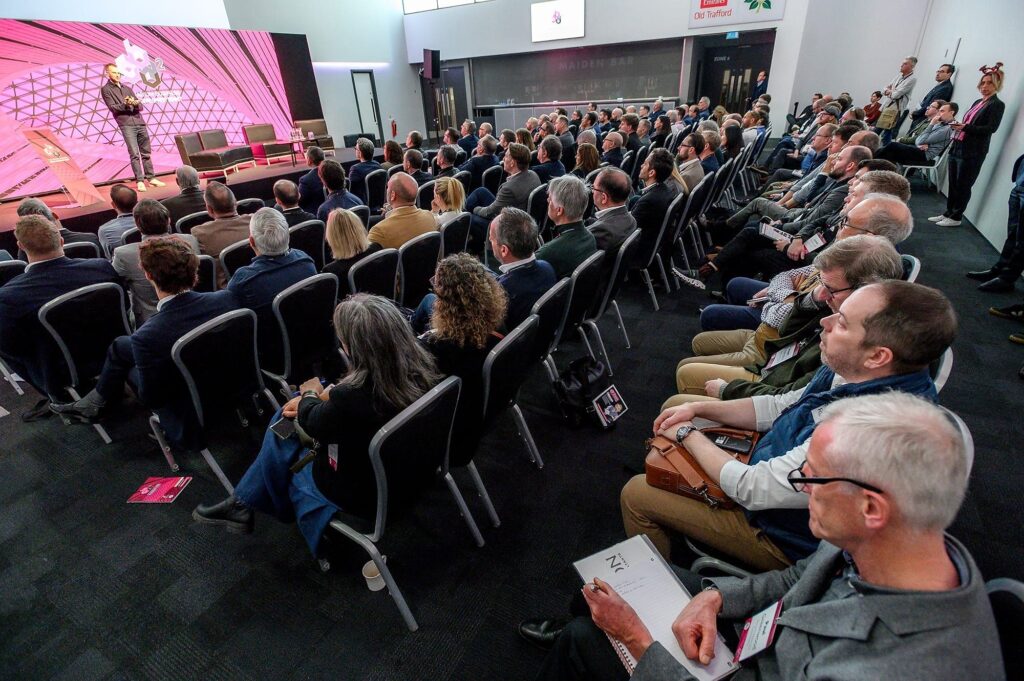
Heatherwick is working alongside MANICA to deliver the vision for the stadium, and Postma disclosed that for the first time the company had received a design brief that “openly called for intimidation” on arrival, for visiting fans at least.
Postma admitted Heatherwick is “pushing the regulations” to the limit to create the steepest bowl allowed, while an acoustic ceiling hanging below the roof will act to “amplify the atmosphere” inside the bowl.
He said that both a retractable roof and pitch is “certainly a significant undertaking”. While the pitch will move under the east stand, a concertina roof is the “current working assumption”.
Postma added that how the club will fill the stadium is a “live conversation with the client, who are really bullish in their ambitions in that sense”.
An authentic place for Everton
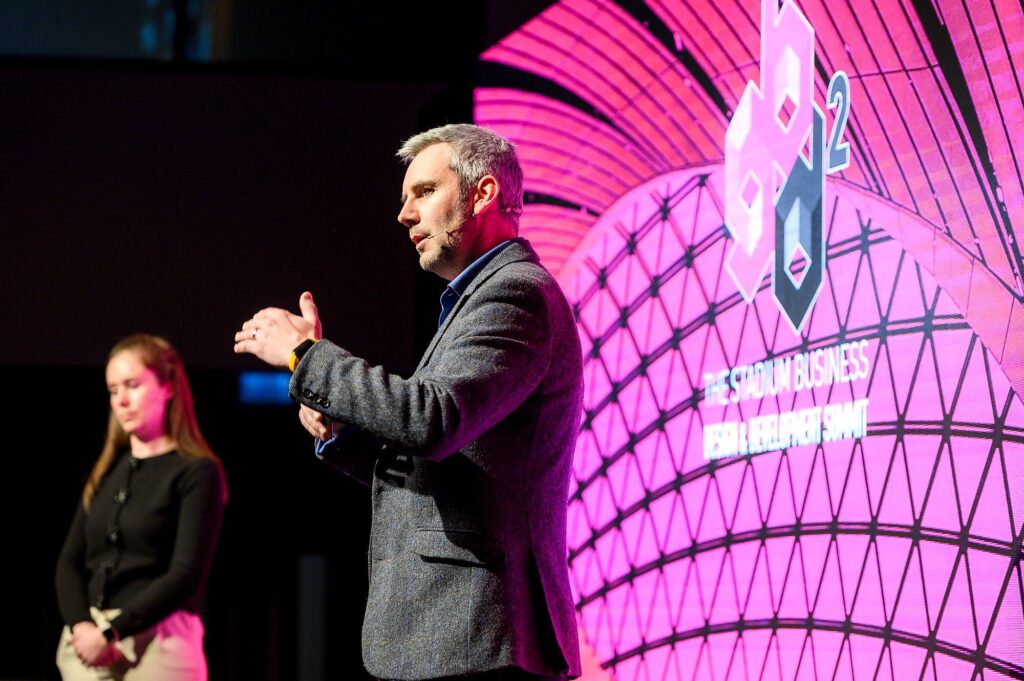
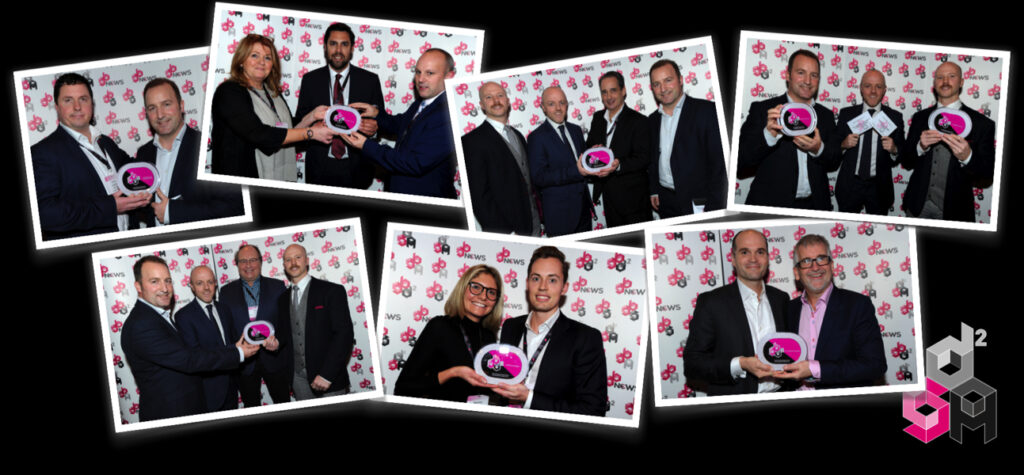
Moving to the present day, after officially opening earlier this year, Hill Dickinson Stadium scooped the hotly contested Project of the Year Award at the TheStadiumBusiness Design & Development Awards 2025 on Wednesday.
Earlier in the day, a case study presented by Alix Waldron, director of new stadium development at Everton FC, and Jon-Scott Kohli, director of BDP Pattern, set out how the Premier League club’s stadium on the waterfront was crafted.
Kohli said that Everton fans see “an authentic place for them and the community”, with the overall result a “collaboration of so many components coming together”.
Day one was stacked with informative panel sessions, commencing with Community Foundations, with a focus on training grounds and community sports infrastructure. Rick van Oosterhout, partner in BeachStadium, said that the project in the Dutch city of The Hague is a concept “we can take worldwide as there are 290 coastal cities across the globe”. He added that BeachStadium was “trying to be the platform” for expanding access to beach and water sports.
Joining Van Oosterhout on the panel were Luke Ritchie, project director of KSS; Ursula Friedmann, chief of non-sports at BSC Young Boys; and Kimmo Siira, director of project development for the City of Lahti.
‘Collaboration is key’
Building What We Design tackled the subject of unlocking the path to construction with Aidan Miller, strategy and projects director for Wrexham AFC, stressing that when a project goes further down the line “you have to have flexibility”. Miller said “collaboration is key”, adding that “going into a contract fighting is never going to lead to a happy outcome”.
David Hickey, executive director of UK projects for CAA Icon, said that for a successful project “you need clarity of brief, assessment of risk and understanding the supply chain”.
Setting the agenda, Rob Amphlett, partner and sports and entertainment sector leader for Buro Happold; and Andrew Downes, head of infrastructure delivery at Tottenham Hotspur, joined the call that bringing a venue to life requires more than just a compelling design.
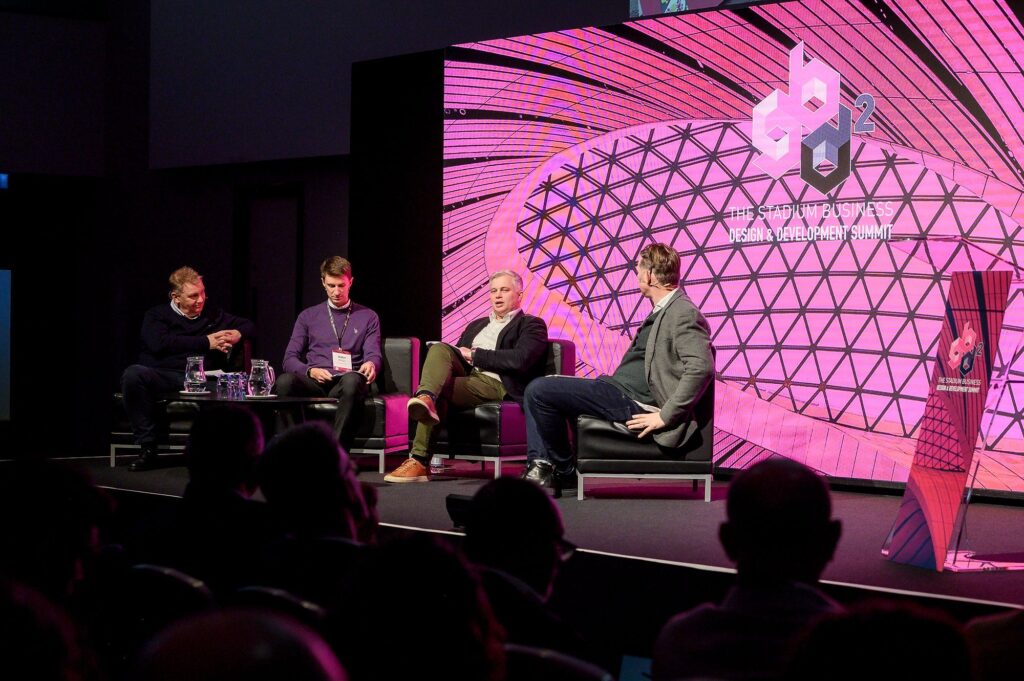
In a panel focusing on how audio-visual innovation is transforming stadiums into immersive entertainment hubs, Patrick Halliwell, managing director in the UK for Daktronics, stated that for AV “you can put the best backbone in, but it’s how you look to create the best experience out of that, through content, which is key”.
Dirk Noy, partner and general manager in Europe for WSDG outlined the belief that “awareness of the complexity, and potential, of AV is now firmly in architects’ minds”. The pair were joined in the debate by Mike Simpson, global design lead for lighting design at Signify.
Meanwhile, on the other stage, AECOM’s global director of sports design Dan Meis and principal and senior design lead Andrea Patry tackled the renovation versus relocation conundrum with a session that explored how to create future-proofed venues.
Disrupting the sector
In a lively session entitled A Whole New Ballgame and moderated by Amy Casterton, director of ES Global, speakers explored how major events and fan trends are disrupting traditional construction approaches.
Hannah Buckley, head of infrastructure, safety and sustainability for the Women’s Super League, who had earlier provided numerous insights into WSL Football’s design guidelines for elite women’s stadiums in an engaging fireside interview, was clear in her message during the panel session.
“Culturally, life is changing and we have to be savvy when planning ahead as to what kind of events will be part of our future,” she said. Rob Sayce, venues lead for Mott MacDonald; Andrea Patry, principal and senior design lead for AECOM; and Gary Sweet, CEO of Luton Town FC also joined the debate.
The day’s final panel session, Invest to Win, looked at stadium transformation for financial sustainability and on-field success. With a focus on Fulham FC’s Riverside Stand, winner of this year’s Hospitality & Premium Award, Lynne Walker, operations and project manager in Europe for Legends Global said a key takeaway is to “really chart the customer journey on the two very different days you want to trade – matchday versus non-matchday”.
She added: “Then you need to factor these potential visitor journeys into the route of the building. Don’t try and match these journeys – they need to be distinct.” Martin Jennings, head of global planning in Europe for Legends Global, added the Riverside, which is set to be fully complete by Q2 2026, is the “most extreme example” in the Premier League of a ‘focus on everyday’ facility rather than just matchday.
The Valencia saga’s spectacular conclusion
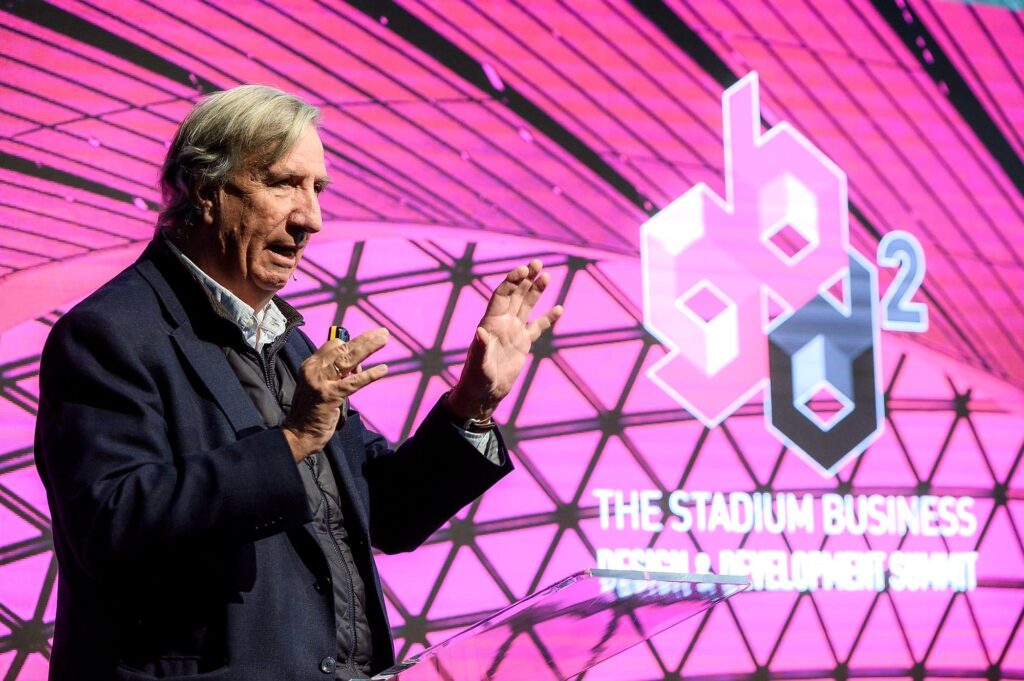
Staying with Awards winners, Mark Fenwick, president and founder of Fenwick Iribarren Architects, was the recipient of the Outstanding Achievement Award and opened day two with an engaging account of the 20-year saga to deliver Valencia CF’s Nou Mestalla.
Highlighting that through the project’s history there have been 11 different presidents of Valencia, and three different mayors of the city, Fenwick pledged that the end result “will be spectacular”. He added: “The old stadium was very introspective, but the new vision with the different terraces that can be used on a daily basis, is very Mediterranean in its outlook.”
Thursday also saw James Saunders, CEO of Quintain, provide a deep dive on the evolution of Wembley Park into a global exemplar for regeneration. Saunders said the Park has now become a “proper suburb of London”, adding “that has always been our goal – a place that people would want to live in”.
He stated that while the perception of the place has “changed dramatically, we’re not done as there’s always things that can be improved, the retail mix being one”. Saunders outlined his belief that the Wembley Park model “can absolutely be taken elsewhere” but stressed that long-term land ownership is key.
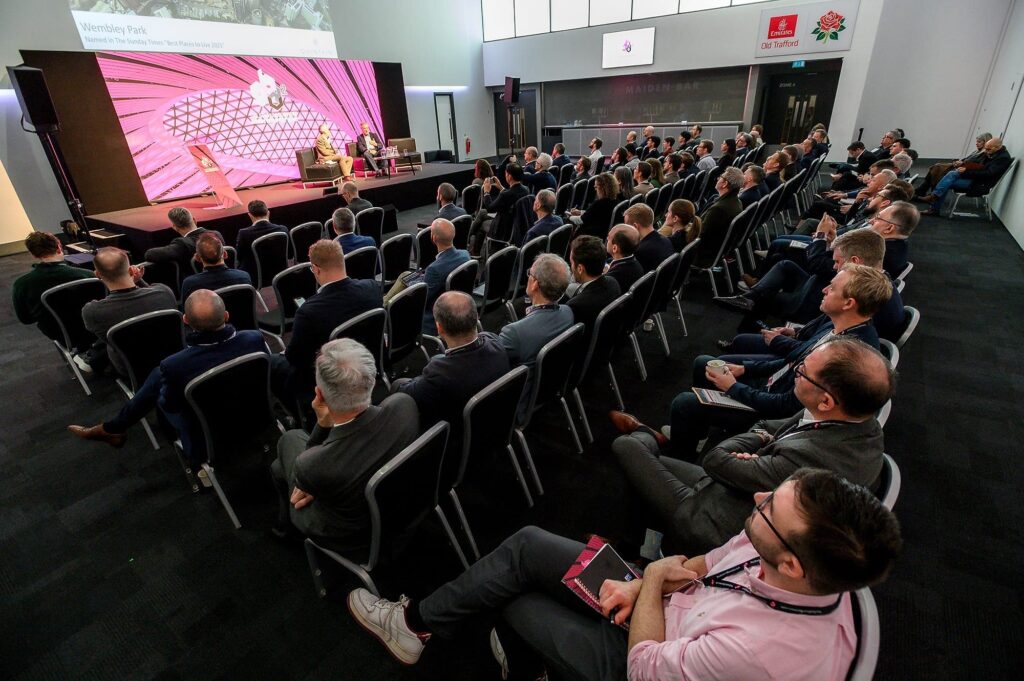
Keeping projects on track
The day’s two panel sessions started with ‘Keeping on Track’, which explored the intricate interplay of the many facets that shape large-scale developments. Disclosing that the newly named Laya Arena and the Royal Dublin Society are “looking at” potentially a 22,000-seat indoor music venue, “akin to Co-op Live”, Greg Power, director of estates, campus strategy and property development, said the secret to delivering a project on time and budget is “getting a couple of superstars in their fields on your team” who are fully aligned on the vision.
Speaking alongside Peter Watts, managing director of Rockvolt, Anthony Willis, partner for construction at Addleshaw Goddard LLP, said you “have to be ready to adapt” through a stadium project, adding “more innovative contracting is required”.
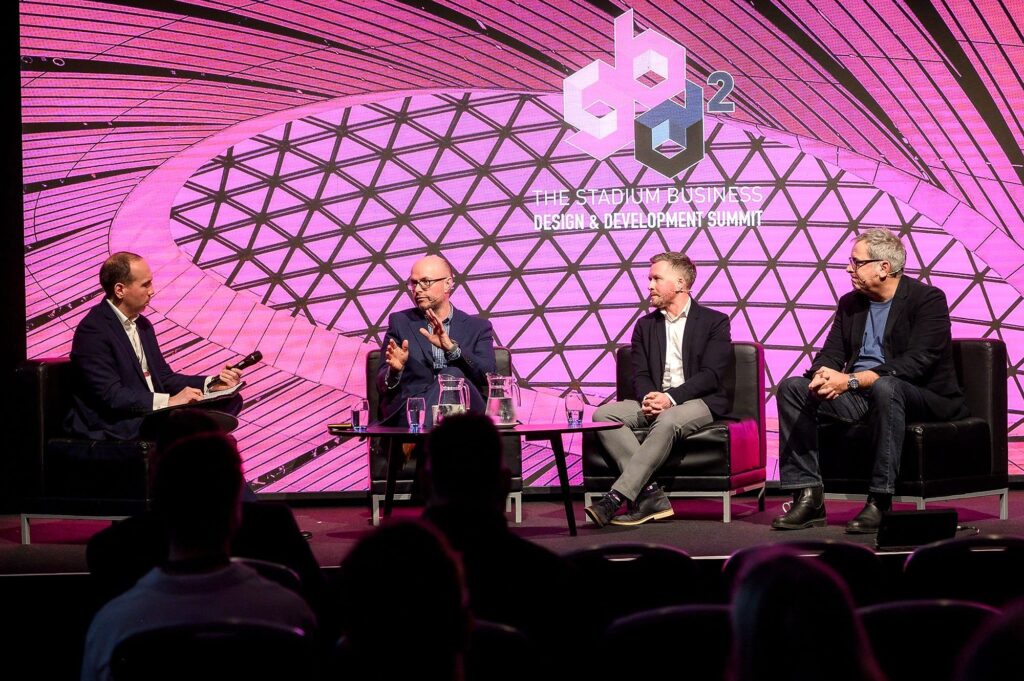
Ritchie of KSS joined John Berry, managing director of Dawnvale, in a panel debating hospitality and premium experiences that provide new spaces in old places. The latter said a lot of clubs are looking at the inside of their stadium, and “asking what space isn’t being utilised”.
He made the call to “listen to your fans, and pay attention to what’s working”, adding “if you have happy fans then they’ll keep coming back”. Ritchie said KSS is “finding we’re looking at projects with the concerts market in mind, for example where will the stage be located and how can hospitality be used in concert mode”. He urged clubs to start the design process “as early as possible”.
Appealing to the next generation
Rounding off #TDS25, Guy Hedderwick, CEO of Shango Consulting, asserted that most venues today are beautiful hardware running on creaking software. His answer? The Programmable Venue.
In an engaging fireside chat to bring the curtain down on this year’s event, Hedderwick set out his stall that “the way we’re designing venues at the moment doesn’t appeal to Gen Z, Gen Alpha and the next generation”.
He outlined: “We have to start realising we’re going to lose fanbase if we don’t start acknowledging the emotion of sport. We need to prioritise goosebumps per minute over tracking crowd flow or dwell time.”
>> View images from the Design & Development Summit on our Flickr feed here.



Share this